

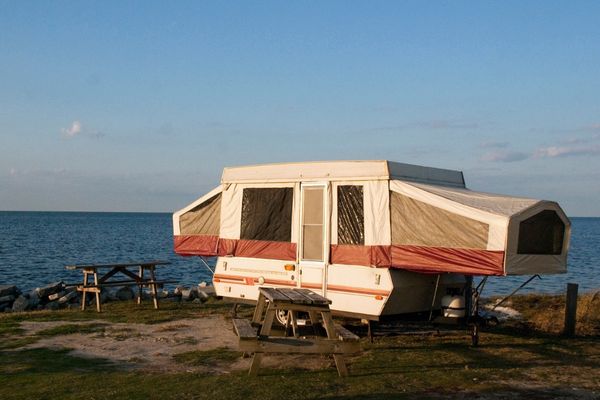
This article is part of an ongoing series designed to help RV shoppers understand the different types of RVs available and decide which option best fits their travel style, budget, and experience level. In this installment, we take a closer look at tent trailers and where they fit in the RV spectrum.
What is a tent trailer (pop-up camper)?
A tent trailer, also known as a pop-up camper, is a type of travel trailer that folds down for towing and storage and expands at the campsite to provide sleeping and living space.
People sometimes overlook tent trailers when shopping for an RV, but pop-ups are worth considering, especially for a family looking to upgrade from tent camping to an RV.
Size, weight, and tow vehicle requirements
Tent trailers are small and light and can be towed by almost any vehicle. Most modern tent trailers are about 10 feet long when folded for transport or storage. Once set up at the campsite, their expanded length is usually about double their tow length.
Most tent trailers have an average dry weight between 1,500 and 3,000 pounds, making them a good option for drivers who want to avoid upgrading their tow vehicle. There are even tiny pop-up trailers that are designed to be towed behind a motorcycle.
Cost
Tent trailers can be a very inexpensive option for larger families. Tent trailers range from about $15,000 to $20,000 when purchased new, depending on the size and amenities. If you’re interested in buying a used pop-up, you can often find them on the resale market for a very low price.
Pro tip: If you’re buying used, inspect the trailer carefully, especially the fabric sides.
Amenities and layout options
Tent trailers often lack typical amenities found in other RV types, such as bathrooms, holding tanks, and even water heaters. The low price point of a new tent trailer generally reflects whether the unit has these features.
Tent trailer camping is very similar to tenting, except you are off the ground, and will at minimum usually have at least a galley sink, furnace, and small fridge.
One trade-off to consider is that tent trailers require more setup and teardown time than hard-sided RVs, since the beds and living space must be deployed and secured at each campsite.
Pop-ups can sleep at least 4 people; many can sleep up to 8. The front and rear pop-out sections of tent trailers typically feature queen beds, but sometimes one or both beds are king-size. Additionally, there is usually a dinette table that folds down into a double bed, and sometimes a small bench seat will double as another bed.
The smallest tent trailers will almost always have two large front and back beds, a furnace, a fridge, and a dinette table.
Larger units may have a longer box, providing slightly more floor space, a small freshwater tank, a water heater, and even a porta-potty in its own tiny water closet. Sometimes there will even be a shower. These more deluxe units may even sport an additional pop-out on the side, allowing for additional space. Think of this pop-out as the tent trailer’s version of a slideout.
Water, waste, and toilets
Tent trailers do not have gray or black water holding tanks, even though they may have a small freshwater tank onboard. Gray water must be captured using a hose connected at one end to a fitting on the outside of the trailer that leads to the sink drain, and a portable holding tank at the other end.
In the case of a unit with a toilet, the toilet will either have its own small holding tank attached or be a composting toilet. Composting toilets are the latest in environmentally friendly products that turn sewage into compost for easy disposal. Many people who purchase tent trailers without onboard toilet facilities eventually choose to carry a separate aftermarket toilet.
Who tent trailers are best for
Because of their size, weight, and simplicity, tent trailers can be a good solution for first-time RV buyers, families transitioning from tent camping, or anyone with a smaller tow vehicle who does not wish to move into a larger RV.
They also appeal to campers who want to keep costs down and maintain a camping experience that remains close to traditional tenting, while still adding some comfort and convenience.
View more blog posts from Steve Froese in the RV type series
- Deciding on a Class A Motorhome? Pros, Cons, & Tips for Buyers
- Class B Motorhomes: Pros, Cons, and Tips for First-Time Buyers
- Class C Motorhomes for New RVers: What You Need to Know
- Pros and Cons of Fifth-Wheel RVs: What to Know Before You Buy
|
Steve Froese is a longtime member of Family RV Association, a nonprofit organization for owners of recreational vehicles, and writes the “Tech Talk” column for Family RVing magazine. He is an experienced RV owner and a certified RV technician in both the United States and Canada. Steve is also a licensed professional engineer in British Columbia and a busy professional musician. |

Leave a Reply